09982292579
info@mehraeen.ac.ir
یک زبان را انتخاب کنید

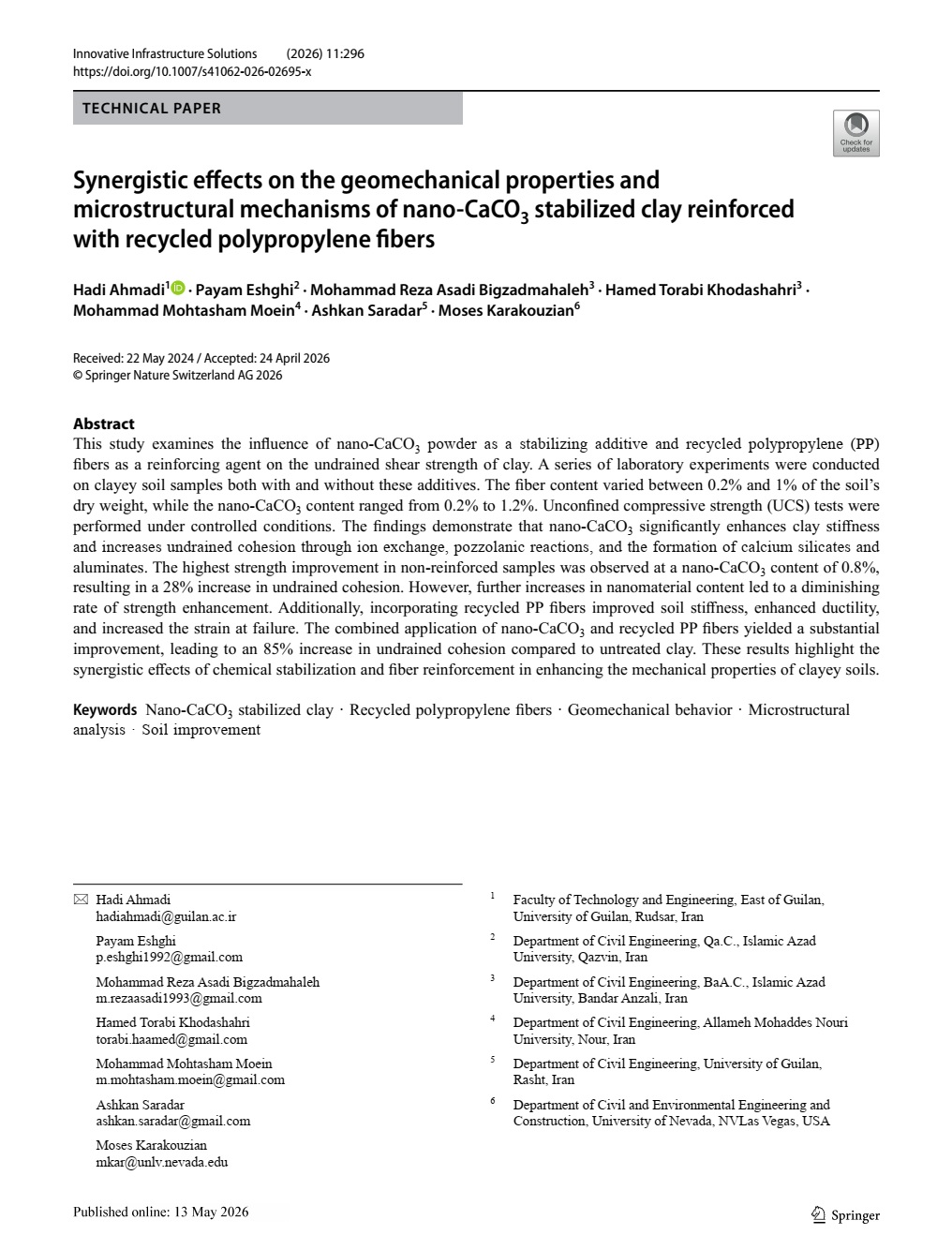
Synergistic effects on the geomechanical properties and microstructural mechanisms of nano-CaCO3 stabilized clay reinforced with recycled polypropylene fibers
Experimental evaluation of mechanical behavior and microstructure in fiber- and nano-treated clay
This study examines the influence of nano-CaCO3 powder as a stabilizing additive and recycled polypropylene (PP) fibers as a reinforcing agent on the undrained shear strength of clay. A series of laboratory experiments were conducted on clayey soil samples both with and without these additives. The fiber content varied between 0.2% and 1% of the soil’s dry weight, while the nano-CaCO3 content ranged from 0.2% to 1.2%. Unconfined compressive strength (UCS) tests were performed under controlled conditions. The findings demonstrate that nano-CaCO3 significantly enhances clay stiffness and increases undrained cohesion through ion exchange, pozzolanic reactions, and the formation of calcium silicates and aluminates. The highest strength improvement in non-reinforced samples was observed at a nano-CaCO3 content of 0.8%, resulting in a 28% increase in undrained cohesion. However, further increases in nanomaterial content led to a diminishing rate of strength enhancement. Additionally, incorporating recycled PP fibers improved soil stiffness, enhanced ductility, and increased the strain at failure. The combined application of nano-CaCO3 and recycled PP fibers yielded a substantial improvement, leading to an 85% increase in undrained cohesion compared to untreated clay. These results highlight the synergistic effects of chemical stabilization and fiber reinforcement in enhancing the mechanical properties of clayey soils.
جناب آقای مهندس پیام عشقی
3
دوره
43
مقالات
مطالب بیشتر از جناب آقای مهندس پیام عشقی


نظرات و پرسشها
در حال مطالعه
Synergistic effects on the geomechanical properties and microstructural mechanisms of nano-CaCO3 stabilized clay reinforced with recycled polypropylene fibers
زمان مطالعه
15 دقیقه

موسسه آموزش عالی مهرآیین
اولین قدم به سوی تسلط را بردارید!
ثبتنام
تماسباما
اعتبارسنجیگواهی
فرمعضویت
دربارهما
قوانینومقررات
سامانه آموزشی
اساتید نخبه
هیأتامنا
پایگاهداده
هیات علمی
تمامی حقوق سایت برای موسسه آموزش عالی مهرآیین محفوظ میباشد.


پاسخ به پرسش